SlopOS
An x86-64 operating system in Rust, written by AI agents and checked by tools that don't take their word for it.
SlopOS is an operating system for x86-64 PCs, written from scratch in Rust. It has its own kernel, drivers, filesystem, network stack, C library, shell and desktop. It boots on a real laptop, and inside QEMU it can compile a new version of itself, install it next to the running one, and boot into it.
Most of the code was written by AI agents. We named the project after what
that usually produces, and then arranged things so that it wouldn't matter.
An agent's claim that its code is correct is worth nothing, so the build
checks instead. One crate (slopos-ostd) holds every line of unsafe Rust in
the kernel, and the compiler refuses unsafe everywhere else. Verus, a proof
checker for Rust, verifies the invariants where a bug in that crate would mean
undefined behaviour rather than an error. Thousands of tests boot the kernel
under QEMU on every change.
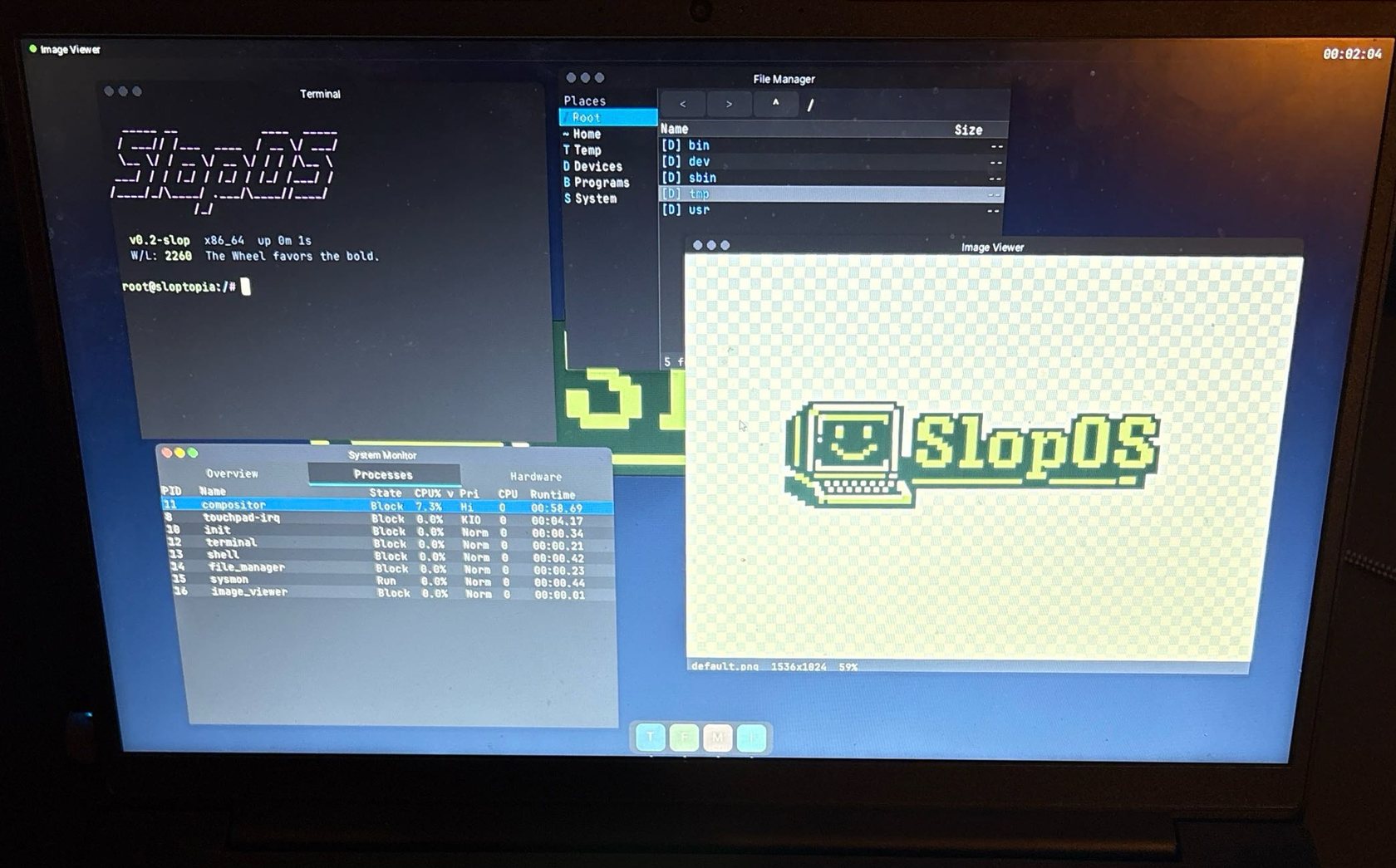
The photo is of a Lenovo laptop running SlopOS directly on its hardware. Our own graphics driver for Intel Xe draws the desktop, and the touchpad was found by reading the hardware description the firmware provides (its ACPI tables).
None of the hard ideas in SlopOS are new. The split between one trusted crate and everything else comes from Asterinas. The system call interface, the signals, the terminal handling and the journal format come from Linux. The source README credits every project we learned from and says what we took from each.
Where to start
To see it run, follow the Quickstart. Two commands boot a live system in a QEMU window.
To understand how it works, start with the Overview, which maps the whole system, and follow whatever catches your interest. If you have never worked on an operating system, Crash recovery is a good first read: it explains what happens to your files when the power goes.
To change it, set up the Development machine, where SlopOS builds and installs itself, then read the guide for what you are touching: Add a syscall, Add a driver or Write tests. When the kernel hangs, Diagnosing the kernel shows how to ask it why.
To know what doesn't work, read Known limitations before you file a bug. It lists what we know is missing, including the gaps we do not plan to close.